Sparken Hill Academy
Phonics
What scheme do we use?
Sparken Hill Academy follows one of the DfE's validated systematic synthetic phonics (SSP) programmes, Bug Club Phonics, to teach phonics from Phase 2 to Phase 6 in Foundation 2 and Key Stage One. Bug Club is a graduated approach that introduces a new sound or rule each day, following a repetitive structure that embeds reading, spelling and writing skills daily.
Year 2 and Key Stage Two children follow the Spelling Shed scheme for phonics and spelling. Children in Key Stage Two who did not pass the Year 1 phonics screening check or the Year 2 re-check still take part in whole-class Spelling Shed teaching, and also receive high-quality, focused phonics intervention during the day so that they catch up.
How do we teach phonics?
Children are taught phonics daily, and every child receives a whole-class, age-related phonics input. Children working below age-related expectations receive small-group or 1-to-1 targeted phonics intervention at another time in the day. A robust tracking system means we monitor every pupil's progress in phonics closely.
Phonics through the ages in FS and KS1
Foundation 1
Phase 1
15 minutes daily with their key worker
Foundation 2
Phase 2 (Autumn), Phase 3 (Spring), Phase 4 (Summer)
20–30 minutes daily
Year 1
Phase 3 recap (Autumn 1), then Phase 5
20–30 minutes daily
Year 2
Year 1 recap (Autumn 1), then Phase 6 with Spelling Shed
20–30 minutes daily
In F1, children begin Phase 1 phonics from their start date, in small-group sessions with their key worker for 15 minutes every day. Phase 1 develops phonological awareness through listening games that help children tell apart environmental, voice and instrument sounds, alongside rhyme, alliteration and rhythm games. Throughout the day children also hear lots of oral segmenting and blending (an adult segmenting d-o-g into each phoneme), which prepares them for Phase 2 in F2.
In F2, children begin Phase 2 in the Autumn term, learning the links between individual letters and their sounds (phoneme–grapheme correspondence). Phase 3 is introduced in the Spring term and Phase 4 in the Summer term. F2 phonics is taught daily for 20–30 minutes.
In Year 1 and Year 2, pupils have a daily phonics session of 20–30 minutes. Year 1 recap Phase 3 in Autumn 1 and are then taught Phase 5 from Autumn 2 to the end of the year. Year 2 recap Year 1 learning in Autumn 1 and are then taught Phase 6 (Spelling Shed) from Autumn 2 to the end of the year.
See below for what children learn in each year.
What scheme do we use?
Sparken Hill Academy follows one of the DfE's validated systematic synthetic phonics (SSP) programmes, Bug Club Phonics, to teach phonics from Phase 2 to Phase 6 in Foundation 2 and Key Stage One. Bug Club is a graduated approach that introduces a new sound or rule each day, following a repetitive structure that embeds reading, spelling and writing skills daily.
Year 2 and Key Stage Two children follow the Spelling Shed scheme for phonics and spelling. Children in Key Stage Two who did not pass the Year 1 phonics screening check or the Year 2 re-check still take part in whole-class Spelling Shed teaching, and also receive high-quality, focused phonics intervention during the day so that they catch up.
How do we teach phonics?
Children are taught phonics daily, and every child receives a whole-class, age-related phonics input. Children working below age-related expectations receive small-group or 1-to-1 targeted phonics intervention at another time in the day. A robust tracking system means we monitor every pupil's progress in phonics closely.
Phonics through the ages in FS and KS1
Foundation 1
Phase 1
15 minutes daily with their key worker
15 minutes daily with their key worker
Foundation 2
Phase 2 (Autumn), Phase 3 (Spring), Phase 4 (Summer)
20–30 minutes daily
20–30 minutes daily
Year 1
Phase 3 recap (Autumn 1), then Phase 5
20–30 minutes daily
20–30 minutes daily
Year 2
Year 1 recap (Autumn 1), then Phase 6 with Spelling Shed
20–30 minutes daily
20–30 minutes daily
In F1, children begin Phase 1 phonics from their start date, in small-group sessions with their key worker for 15 minutes every day. Phase 1 develops phonological awareness through listening games that help children tell apart environmental, voice and instrument sounds, alongside rhyme, alliteration and rhythm games. Throughout the day children also hear lots of oral segmenting and blending (an adult segmenting d-o-g into each phoneme), which prepares them for Phase 2 in F2.
In F2, children begin Phase 2 in the Autumn term, learning the links between individual letters and their sounds (phoneme–grapheme correspondence). Phase 3 is introduced in the Spring term and Phase 4 in the Summer term. F2 phonics is taught daily for 20–30 minutes.
In Year 1 and Year 2, pupils have a daily phonics session of 20–30 minutes. Year 1 recap Phase 3 in Autumn 1 and are then taught Phase 5 from Autumn 2 to the end of the year. Year 2 recap Year 1 learning in Autumn 1 and are then taught Phase 6 (Spelling Shed) from Autumn 2 to the end of the year.
See below for what children learn in each year.


Phonics in Foundation Stage 2
The phonemes children will learn:


The tricky words children will learn:


Phonics in Key Stage One
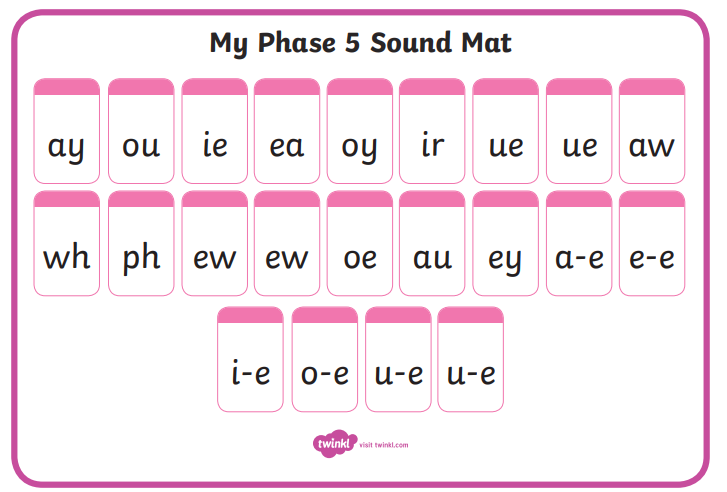
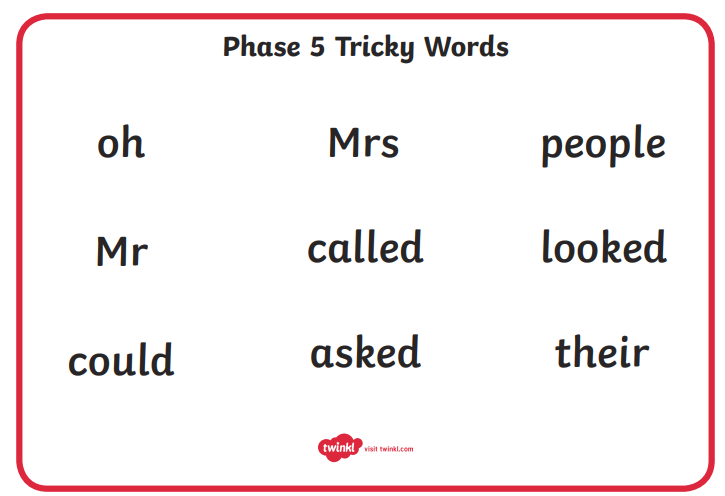
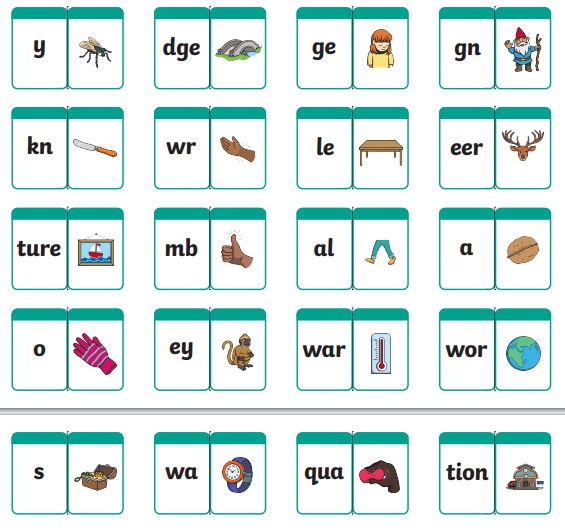
Tricky words your child will learn in Y2:


Phonics Screening Check in Y1
In Year 1 all pupils nationally complete the phonics screening check. The Y1 phonics screening check will take place 14th-19th of June 2027. The purpose of the phonics screening check is to confirm that all children have learned phonic decoding to an age-appropriate standard.
- The phonics screening check will be constructed of 20 real words and 20 pseudo-words (nonsense words).
- The pseudo-words provide the purest assessment of phonic decoding because they will be new to all children, and so there will be no unintended bias based on visual memory of words or vocabulary knowledge.
- The phonics screen check will be scored by your child's teacher. For each word, the teacher will record whether the child read the word correctly or not.
- The pass mark for previous tests was 32/40 but this 2026 was reduced to 31. We are not informed until the tests are complete what the actual pass mark is but these should provide a rough guide to the accepted pass mark.
Does it matter if my child doesn't pass?
No. Children who have not reached this level should receive extra support from their school to ensure they can improve their decoding skills, and will then have the opportunity to retake the phonics screening check again in Y2.
Y1 Phonics screening check resources for parents
Information from the parent workshops (14&16.10.25)