Sparken Hill Academy
Geography
Sparken Hill Academy - Geography Curriculum
Geography
A high-quality geography curriculum should inspire in pupils a curiosity and fascination about the world and its people that will remain with them for the rest of their lives.
Why we teach geography
Geography teaching equips pupils with knowledge about diverse places, people, resources, and natural and human environments, together with a deep understanding of the Earth's key physical and human processes.
At Sparken Hill, our geography curriculum is carefully sequenced so that, as pupils progress, their growing knowledge of the world deepens their understanding of how physical and human processes interact, and how landscapes and environments are formed and used. Geographical knowledge, understanding and skills give children the frameworks to explain how the Earth's features, at different scales, are shaped, interconnected and change over time. We want our children to enjoy and love learning about geography, not just in the classroom but through fieldwork, investigation and enquiry.
The National Curriculum aims for all pupils to
Know where places are
Develop contextual knowledge of globally significant places, on land and at sea, and their physical and human characteristics.
Understand processes
Understand the processes behind key physical and human features, how they are interdependent, and how they bring about variation and change over time.
Use geographical skills
- Collect, analyse and communicate data from fieldwork
- Interpret maps, diagrams, globes, aerial photographs and GIS
- Communicate geographical information through maps and writing at length
How we teach geography
Our geography curriculum meets the objectives of the National Curriculum and is progressive throughout the whole school. Each unit is linked to a class topic and has a small number of clear "to know" statements, reflecting our whole-school approach of Doing Less. Well. and our Golden Thread.
Three milestones
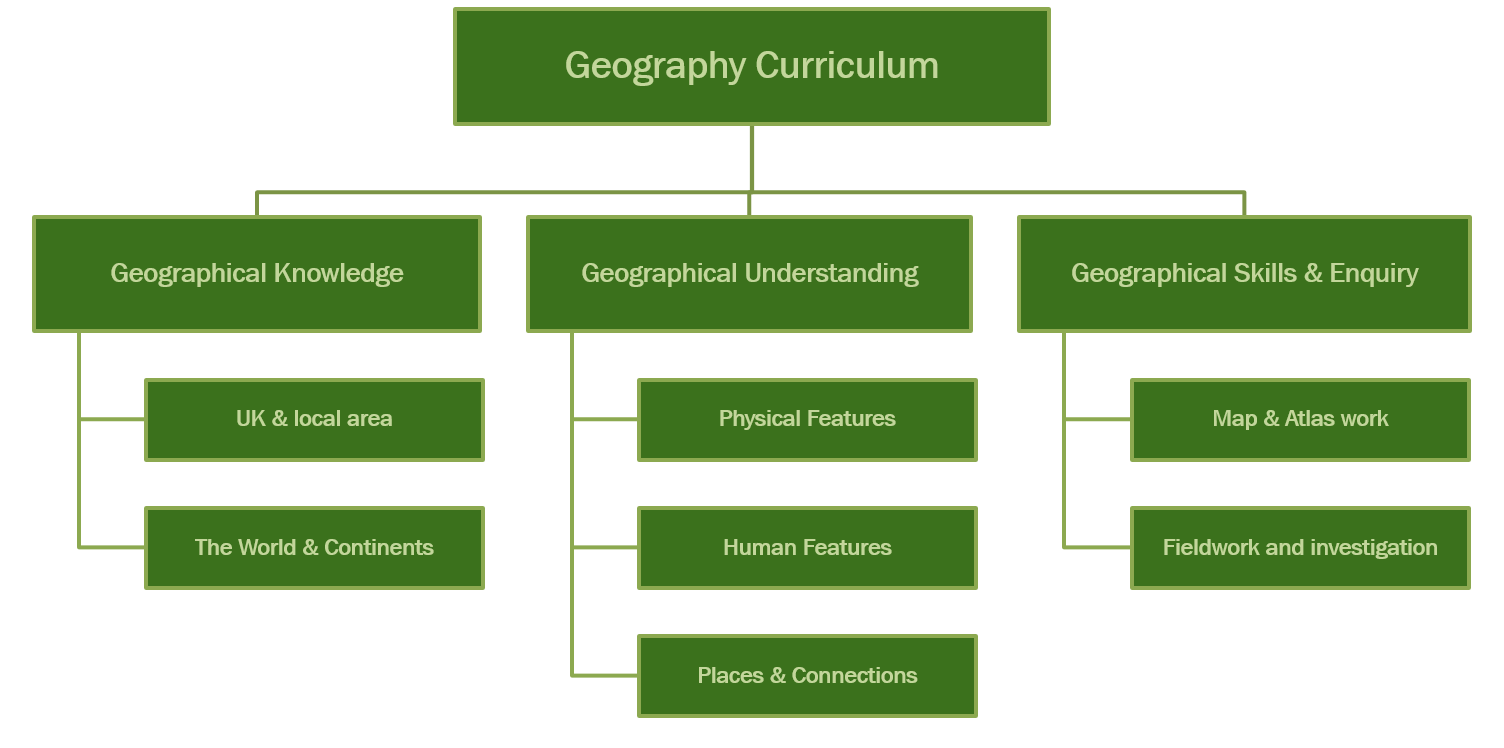
Learning builds through three milestones. Each includes objectives from three threshold concepts: geographical knowledge, geographical understanding and geographical skills and enquiry.
Key Stage 1
Naming and locating the countries of the UK, continents and oceans; comparing our locality with contrasting places; simple maps, compass directions and fieldwork.
Lower Key Stage 2
Climate zones and biomes; settlements and land use; grid references and OS maps; fieldwork in the local area and a National Park.
Upper Key Stage 2
Volcanoes, earthquakes, rivers and mountains; comparing regions of the UK, Europe and the wider world; six-figure grid references and contour lines.
From Worksop to the wider world
Children start with what they know and zoom out, studying places at every scale.
Our local areaWorksop, Manton and our collieries, Conisbrough, Creswell Crags
The United KingdomLondon, Cleethorpes, the Peak District and Castleton, Kinder Scout, the East Midlands
EuropeThe South Aegean in Greece, Mount Etna
The wider worldThe Arctic, the Amazon, Kenya, the River Nile, the Sahara, the Rockies, Darwin, St Lucia, Singapore and the Maldives
What this looks like in school
- Progressive skills embedded in every unit, with regular retrieval of prior knowledge and vocabulary
- Whole-class teaching supported through questioning and varied ways of recording
- Trips, visiting experts and fieldwork, from a local area walk to the Manton pit-top and Castleton
30Geography is taught on a half-termly timetable, giving approximately 30 hours of geography each year.
Foundation Stage
Following Development Matters, our Nursery and Reception children develop their Understanding of the World, learning about people, communities and the natural world. They explore their school and local area and talk about places near and far, so they come into Key Stage 1 with the foundations for geography already laid.
What children achieve
Children's knowledge and skills develop progressively as they move through the school. They gain a deep knowledge, understanding and appreciation of their local area and its place within the wider geographical context, and become more analytical, critical thinkers.
Knowledgeable
Children know where places are and can describe their physical and human features.
Skilled geographers
They use maps, data and fieldwork to investigate and explain the world.
Proud of where they live
They understand Worksop and how it connects with the rest of the world.
How we measure impact
- Pupils' booksA broad and balanced curriculum with the right pitch and challenge, and standards that match those in English and maths
- Long-term plansA clear progression of knowledge and skills across KS1 and KS2, building on prior learning
- Pupil voiceChildren talking about their learning
- Teacher judgementsTermly assessments that track progress and inform planning
Whole School Learning Journey - Geography
Geography: Whole School Journey From Worksop to the wider world. Every geography unit sits within a class topic and is driven by an enquiry question. Follow the road from Reception to Year 6 to see the places children study, from our own local area to continents across the globe. E = even year, O = odd year. The four strands of geography Reception: the journey starts in Wonderful Worksop. Children walk into town, spot landmarks such as Worksop Priory, the canal and the Market Place, look at aerial photographs and simple maps, and talk about places in the world that are very different from Worksop.
Y5/6O
Y5/6E
Y3/4O
Y3/4E
Y1/2O
Y1/2E
YearR